Summary
This species, originally from NSW and Queensland, is widely reared in captivity throughout the world and is the most popular stick insect pet in Europe and North America.
Identifiying features
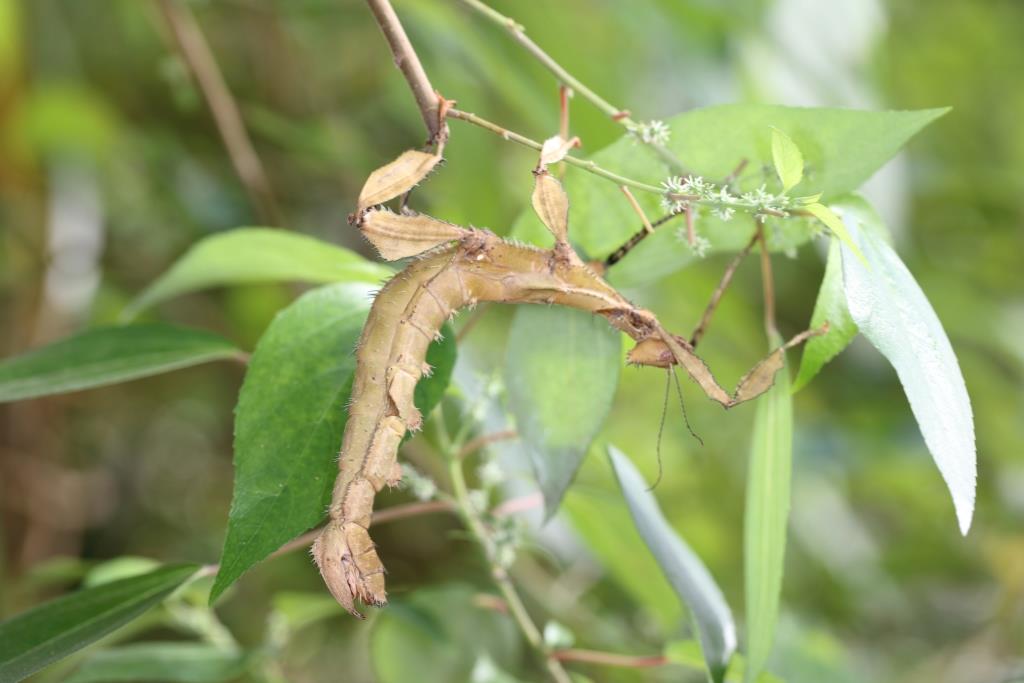
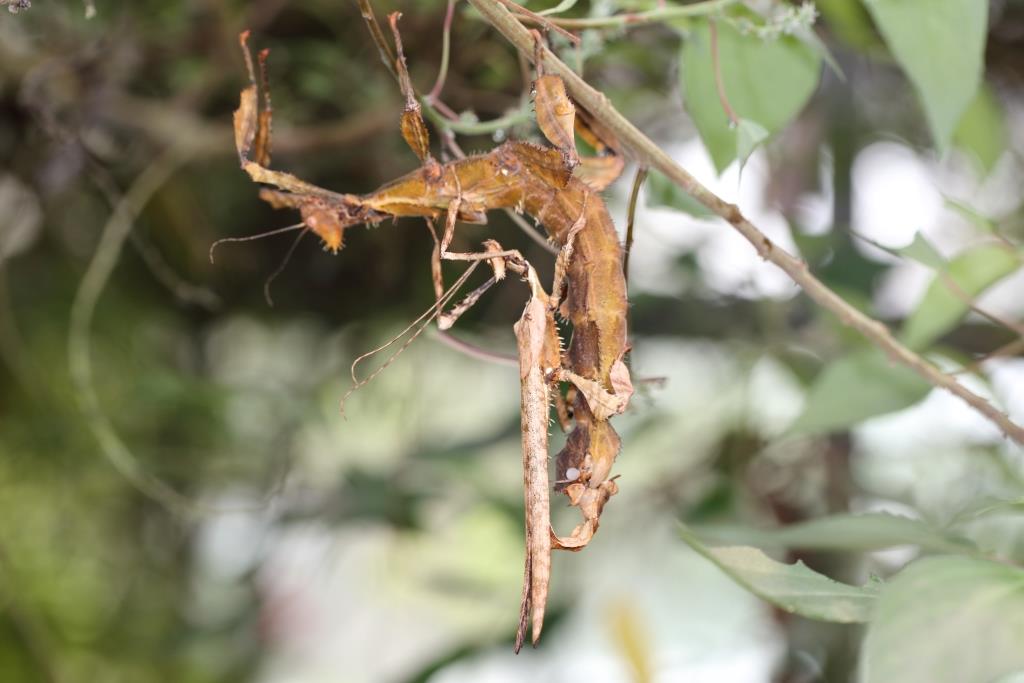
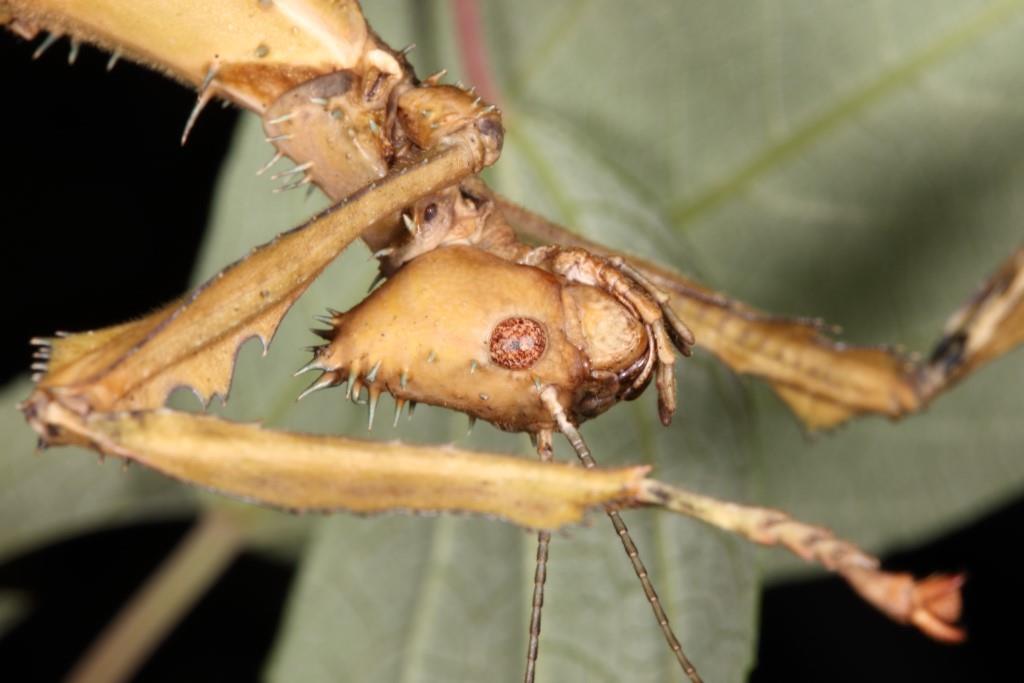
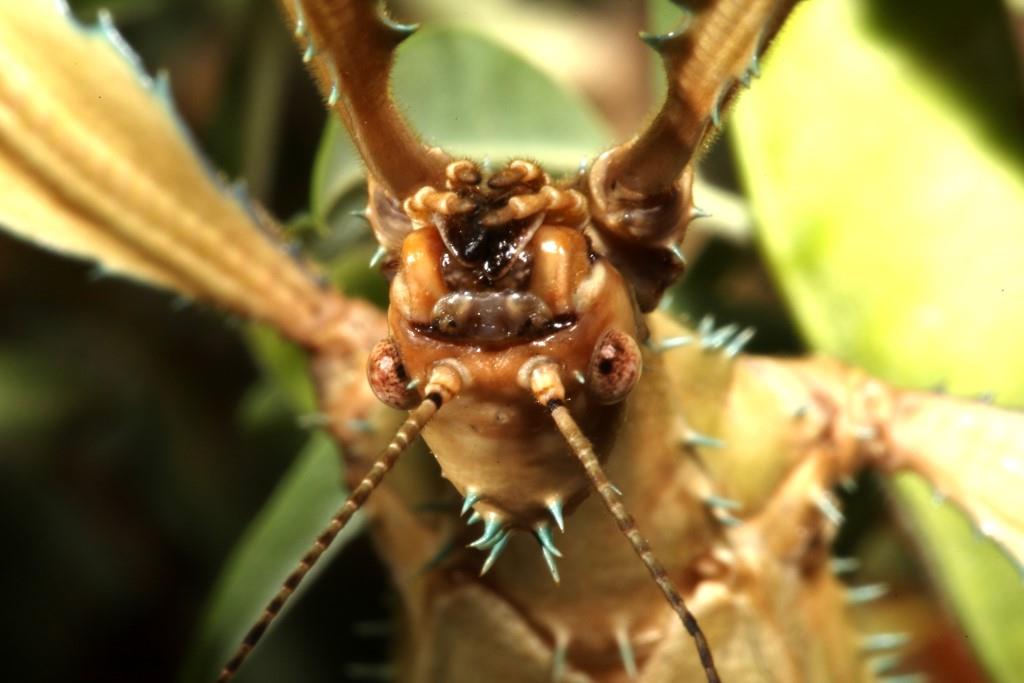
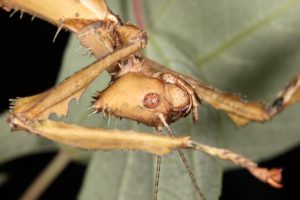
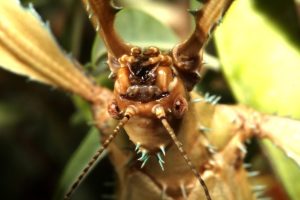
Triangular head, thick body with small spines and flanges on legs (female), long antennae (male)
Similar species
No similar species found.
 ?>
?>
 ?>
?>
 ?>
?>
 ?>
?>
 ?>
?>

Other common names
- Spiny Leaf Insect
- Giant Prickly Stick Insect
- Macleay’s Spectre
- Macleay’s Dilated-Bodied Spectre
Year & describer
Macleay 1826
Details
- Description
-
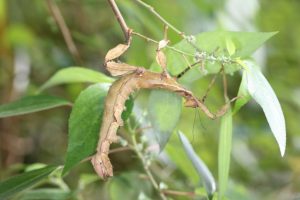
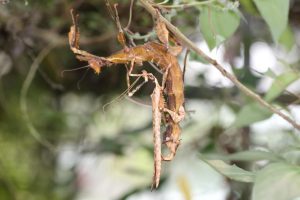
Females are large and wingless, with numerous spines on the thick, leaf-like body and legs, and wide flanges on the abdomen and legs.
Males are generally dark brown with large mottled wings, which look like dried leaves when at rest. The body is much more slender than the female’s and the body and legs much less spiny. There are three noticeable simple eyes (called ocelli) in a tight group on top of the head and the antenna are much longer than those of the female.
- Variation
-
The colour of the females is incredibly variable, ranging from brown, through reddish and greenish to pale greenish-yellow, depending in part on the type of food plant they consume during development.
Adults that are half male and half female (called bilateral gynandromorphs) are also rarely produced. In these specimens the right half of the body is male and winged and the left half female and wingless. They are probably unable to survive in the wild and are always unable to reproduce. Specimens may also occur with extremely long antennae.
- Size
-
Males reach 90mm long, whilst females vary more in size, generally 120-150mm.
Females may weigh more than 20g.
There is some variation in the size of adults of this species, determined in part by the food plant, by the amount of food consumed, and by the method of reproduction (sexual or parthenogenetic). - Distribution
-
The range of this species, like the taxonomy, is under debate. Various authors state only Queensland, or New South Wales and Queensland, or the entire east coast of Australia.
- Habitat
-
Spiny Stick Insects occur in a number of habitats – rainforest, wet and sometimes dry forest where the food plants are available. The nymphs are apparently commonly found amongst bracken where they are very well camouflaged. This species also occurs in suburban areas and is sometimes found in gardens feeding on ornamental trees.
- Nocturnal/diurnal
-
Most active nocturnally.
- Life cycle
-
The life cycle begins with an egg, which hatches into a nymph and eventually becomes adult. There may be two distinct hatching periods, depending on whether eggs are produced by mating or not– the incubation time is about 7 and 19 months respectively. The ability of females to produce fertile eggs without mating (called parthenogenesis) is common in stick insects and the offspring are identical clones of the mother.
The eggs appear to be attractive to ants and may be collected by workers and taken underground into the nest, where the egg is protected from predators able to chew through the thick shell. It often leaves the nymph, however, in a difficult situation when it hatches in the middle of a nest. The nymphs appear to have no protection against this situation other than mimicry, speed and the ability to drop their limbs (called autotomy). Most eggs probably hatch amongst leaf litter in which they were dropped by the female from foliage.
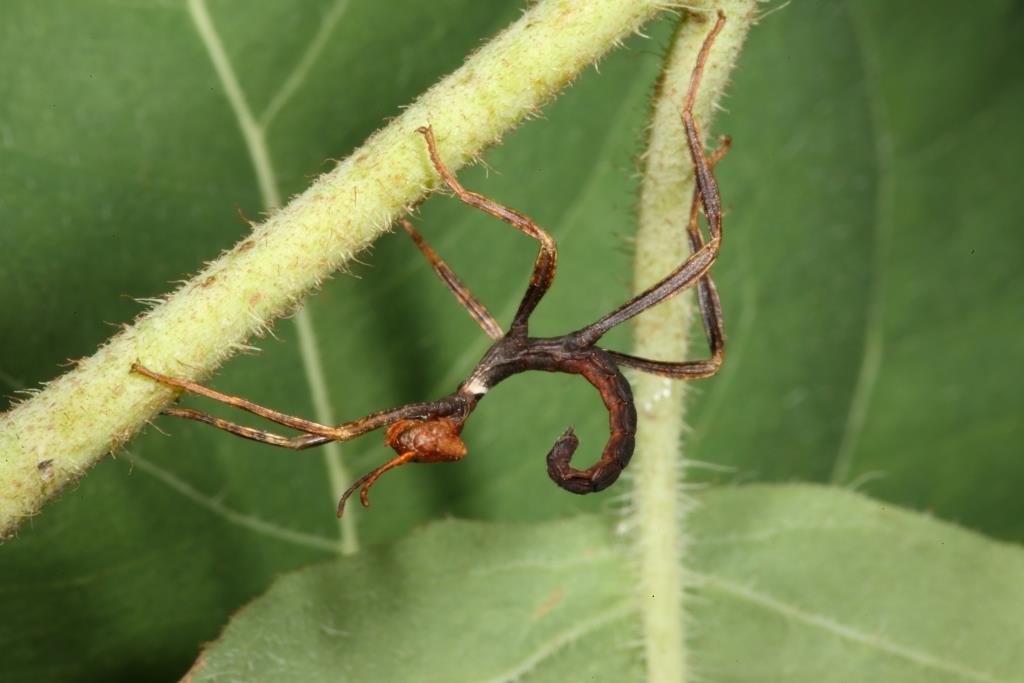
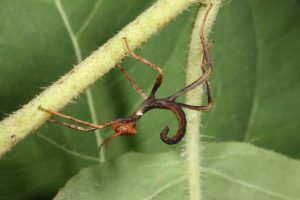
The first instar nymph is very active and walks (at up to 100mm per second) with its abdomen curled at least once over its back. It is black with an orange head and white collar, and bears a strong resemblance to ants (Leptomyrmex species) which occur within the stick insects’ natural range. The nymphs are excellent at avoiding ants and can escape even if captured by up to two ants at the same time. Newly hatched nymphs can survive for about two weeks without food but with water, and for 6-10 days without either.
Females moult four times during development and males five times. Nymphs of both sexes are of similar length at the same age, with the male increasing in length following the extra moult. Moulting usually occurs around dusk. The time from egg to adult is about 100 days, depending on the temperature. Adults live for about 140 days after the final moult (and between 8 and 12 months for the entire life cycle).
- Courtship/mating
-
Mating for female Spiny Stick Insects begins a few days after the final moult and generally commences in the evening and ends the next morning, lasting 15-19 hours. Females may mate 12 times or more during their adult life, with a minimum period of a few days between each episode. Mating activity peaks at about 46 days after reaching maturity, and there is almost no mating activity towards the end of her life. Mating occurs with the male on the holding on to the back of the female with his reproductive organs attached at the side of the female’s.
The sperm is transferred to the female in a spermatophore, a white conspicuous stalked vesicle about 2mm in diametre, which can be found attached to the female following mating and which she discards soon after. Smaller males tend to mate for longer periods than larger ones, presumably because the female is able to carry a smaller male for a longer period.
Eggs are laid about 14 days after mating. The female will not produce eggs until 33 days after her final moult, and if she has not mated by this stage she will produce fertile eggs on her own, which are exact copies of their mother. Males are significantly more attracted to females before they begin egg laying than after, suggesting the presence of a pheremone which is turned off (or turned down) after egg laying commences. There is also some evidence that females attract males with flashes of ultraviolet light.
An egg may be carried by the female for several hours before laying. The egg is enclosed in a pouch at the end of the female’s abdomen (called the genital pouch), where it can be clearly seen. Eggs are generally dropped whilst the female is hanging upside down in foliage, and she will produce about five eggs per day. The female will shudder convulsively before catapulting the egg up to 2m away with a flick of the abdomen. Spiny Stick Insects are messy feeders, dropping large pieces of uneaten leaves to the floor. These pieces, coupled with piles of faeces (called frass), may attract predators in the wild, and the egg-flicking apparently reduces the chances of predators, attracted to the leaves, from finding the eggs.
Upon laying, the egg is yellow with a mottled brown pattern, which darkens as the egg ages. It has a distinct cap (called an operculum), which may be missing if the egg is damaged, with a yellow stripe down the side. Eggs weigh between 36-40mg and there is no significant difference in size between eggs produced sexually and by parthenogenesis. The eggs are on average 4mm long and 3.3mm wide and may become smaller as a female ages. Females may lay more than 500 eggs each. There is a strong positive relationship between the size of the female and the size of the egg.
- Diet
-
In the wild, Spiny Stick Insects feed primarily on gum trees (Eucalyptus species), such as Spotted Gum (Eucalyptus maculata), Queensland Grey Gum (Eucalyptus major) and Forest Red Gum (Eucalyptus tereticornis), and will also readily feed on a range of Paperbarks (Melaleuca species) and Wattles (Acacia species) which occur within their natural range. In suburban areas they may feed on ornamental plants such as Rose (Rosa spp and other species within the family) and Apricot (Prunus amygdalus).
- Natural enemies
-
The natural enemies of Spiny Stick Insects are few, but they are probably attacked by observant birds that can find them amongst foliage and that are not perturbed by the scorpion-like appearance.
- Defences
-
Like other stick insect species, Spiny Stick Insects can shed (autotomise) limbs as defence. This takes place at the base of the leg (closest to the body), and nymphs can progressively grow back the limbs with each moult, although the replacement leg will generally not reach the full length of other entire legs. Adults may also shed legs even though there is no chance of regrowth. In this species, the process may go awry when a lost antenna grows back as a miniature leg sprouting from the head, instead of a new antenna.
Females possess defensive glands which exude an offensive fluid when disturbed. The fluid has a strong smell but causes no other known side effects. Males, when threatened, will also produce this fluid but not in such quantities as the female.
- Seasonal activity
-
Spiny Stick Insects tend to be seasonal, particularly in the southern part of the range. In the northern part of the range they are apparently common throughout the year. Adults mature during November in the north.
- Behaviour
-
Females in the wild are generally solitary and males are apparently rare. Both are active during the day. Females are not strictly territorial but may kick out at other females that approach too closely. They will generally tolerate the presence of a male. The female hangs upside down from foliage with the abdomen curled over the back like a scorpion, and moves only slowly and occasionally through the foliage, feeding on leaves within reach. The males are more active and will fly readily, and are one of the few stick insects able to gain elevation during flight.
- Native/introduced
-
Native
- Conservation status
-
No concern.
- Captive breeding
-
The enclosure needs to be large enough to allow your stick insect to shed its exoskeleton properly. An enclosure should be higher than it is wide, as stick insects like to climb upwards. Minimum size requirements are 35cm high x 30cm wide x 30cm deep. Place the enclosure in a spot where it gets a bit of daylight each day, but be careful it doesn’t overheat them.
The enclosure needs to be large enough to allow your stick insect to shed its exoskeleton properly. An enclosure should be higher than it is wide, as stick insects like to climb upwards. Minimum size requirements are 35cm high x 30cm wide x 30cm deep. Place the enclosure in a spot where it gets a bit of daylight each day, but be careful it doesn’t over heat in direct sunlight. Make sure there is plenty of ventilation in your enclosure.
Sometimes stick insects will not shed their exoskeleton properly. This may be because there isn’t enough room in the enclosure for them to do so, or that their environment is too dry and their new exoskeleton hardens before they can free themselves from the old one. They can also lose limbs through the moulting process if they aren’t hanging correctly whilst moulting. They can regrow lost limbs at their next moult, but need at least two moults to regrow a limb to a usable size.