Summary
One of the largest butterfly species in Australia, a common sight around orchards and garden Citrus.
Identifiying features
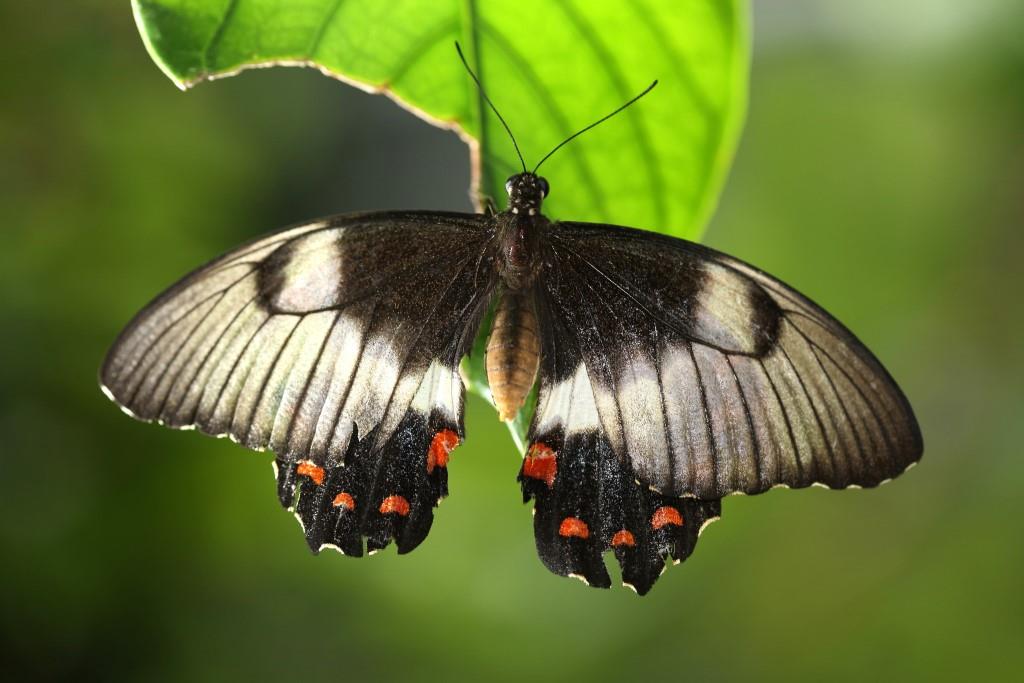
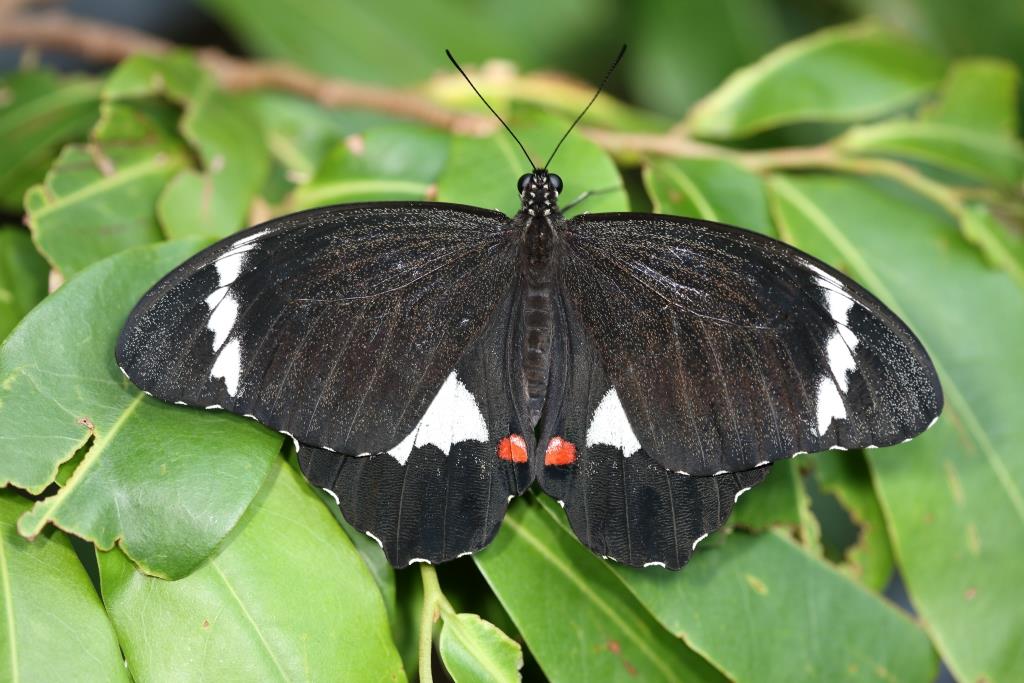
Mostly black with two large red spots on hindwings (males), mostly white with four large red spots on hindwings (females).
Similar species
No similar species found.
 ?>
?>
 ?>
?>
 ?>
?>
 ?>
?>
 ?>
?>
 ?>
?>
Other common names
- Orchard Butterfly
- Large Citrus Butterfly
Year & describer
Donovan 1805
Details
- Description
-
Both males and females are black and white with small patches of red and blue. Males are easily distinguished from females by a much greater proportion of black on both the forewings and hindwings, particularly on the underside.
- Variation
-
A pale form of the female (called form ‘beatrix’) is found in North Queensland and may be a mimic of the Pearl Owl butterfly (Taenaris artemis), which is found only on the tip of Cape York.
Probably more than any other Australian butterfly, this species may produce adults that are part male and part female (called gynandromorphs), that are generally infertile. There may be bilateral gynandromorphs which are split perfectly down the middle, or mosaic gynandromorphs, which are only partly male (such as a single forewing or hindwing) and mostly female, or vice versa.
Females of both P.a.aegeus and P.a.ormenus have three forms; regular, pale and dark. The pale form has yellow spots on the hindwings, compared to the usual red spots. The forewings are almost completely white. The front wings of the dark form are almost completely black and the hindwings have a smaller white patch.
Six subspecies are recognised:
- Papilio aegeus aegeus Cape York – East Victoria, South Australia
- Papilio aegeus adrastus C. & R. Felder, [1864]— Banda Group
- Papilio aegeus aegatinus Rothschild, 1908— Noemfoor Island
- Papilio aegeus goramensis Rothschild, 1908 — Goram Island
- Papilio aegeus keianus Rothschild, 1896 — Kai Island
- Papilio aegeus kissuanus Rothschild, 1908 — Watubela Island, Goram Island
- Papilio aegeus oritas Godman & Salvin, 1879 — New Ireland, New Hanover
- Papilio aegeus ormenulus Fruhstorfer, 1902 — Fergusson Island
- Papilio aegeus ormenus Guérin-Méneville, [1831] — Aru, Missol, Salawari, Jobi, Waigen, West Irian, Papua, New Guinea, Trobriand, D’Entrecastreaux, Woodlark, Lousiades, Torres Straits Is
- Papilio aegeus othello Grose-Smith, 1894 — Biak
- Papilio aegeus websteri Grose-Smith, 1894 — New Britain
- Size
-
The male wingspan reaches 102mm and the female 108mm.
- Distribution
-
This species is found along the east coast of Australia on both sides of the Dividing Range, with isolated patches further west, such as Dubbo, Adelaide, Alice Springs and Darwin, and occasionally in Victoria.
- Habitat
-
This species occurs in a wide range of habitats, from rainforest and dry woodlands to suburban areas. The ability of Orchard Swallowtail caterpillars to feed on introduced citrus appears to have significantly increased their range last century. They are common on citrus in residential gardens and can become a minor pest in orchards, particularly in the Murray irrigation region.
- Nocturnal/diurnal
-
Adults are active diurnally.
- Life cycle
-
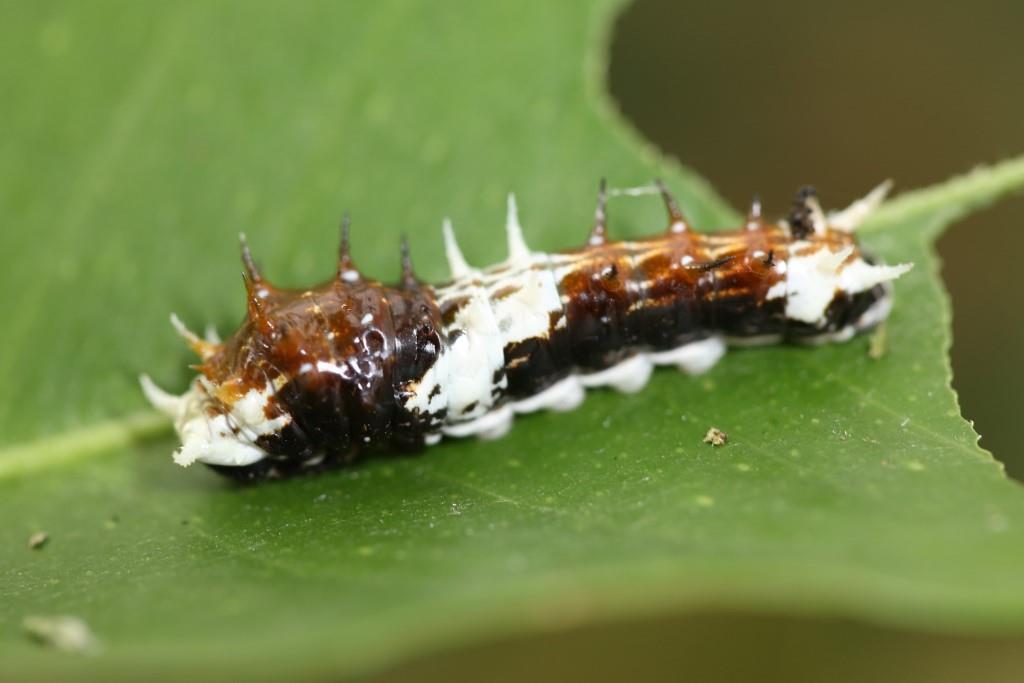
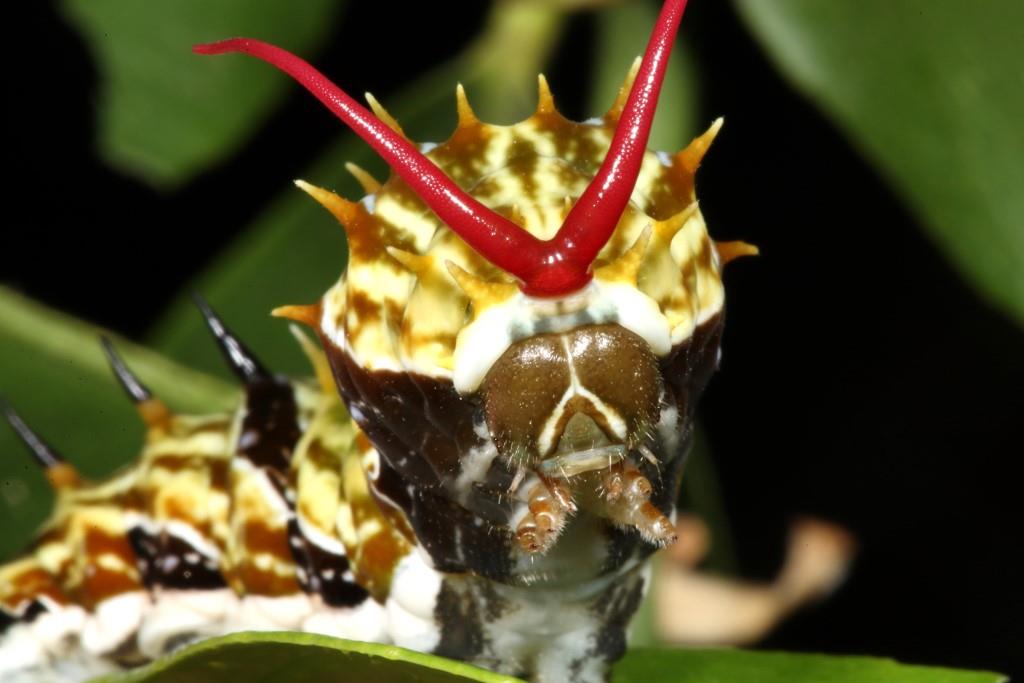
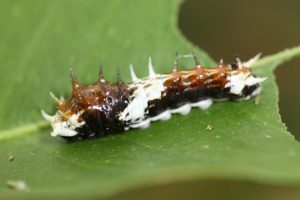
The eggs are round and pale yellow, 1.5mm wide and laid singly on young shoots or along the edges of larger leaves of the food plant. The egg hatches in about a week and the young caterpillar eats the egg shell as its first meal. Until the second moult, the young caterpillar looks very much like a bird dropping, which apparently helps protect it from predation by birds. As it grows older it becomes green with irregular and variable yellowish-white markings. Older individuals also have a slight hump behind the head.
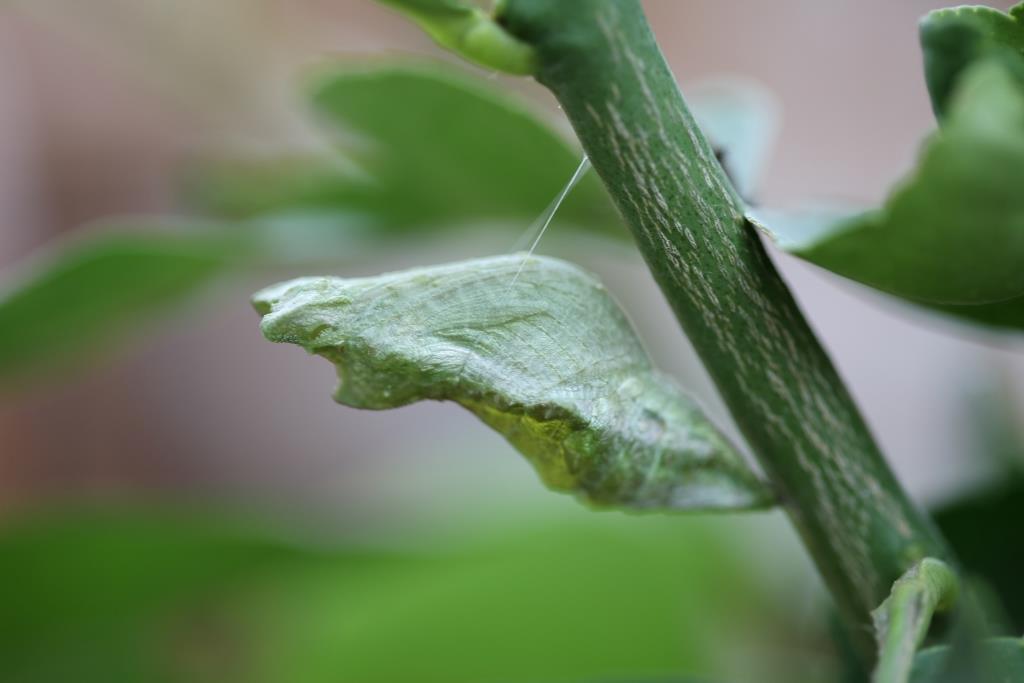
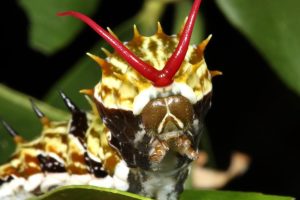
Caterpillars feed singly during the day and rest at night. The caterpillar moults four times before pupating, but occasionally a fifth moult will take place and the resulting larger caterpillar has a different pattern to normal caterpillars (figure x). When finished feeding, it attaches itself at the rear end to the plant with a silken pad, then threads a single strand of silk (called a girdle) from the plant and around its middle for support. It remains in this position for about a day before shedding its skin and pupating. Caterpillars take about a month to develop from egg to pupa, depending on temperature and daylength.
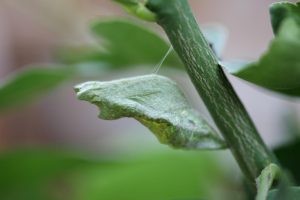
The pupa varies in size (32-40mm) depending on the amount of food consumed as a caterpillar. Colour varies from green to brown, often with darker mottling, determined in part by the pupa’s location on the plant, generally green when pupating amongst leaves and brown when further down towards the trunk.Adults emerge in the early morning and hang from the empty pupal case for several hours before expelling liquid wastes generated during pupation, and flying off.
- Courtship/mating
-
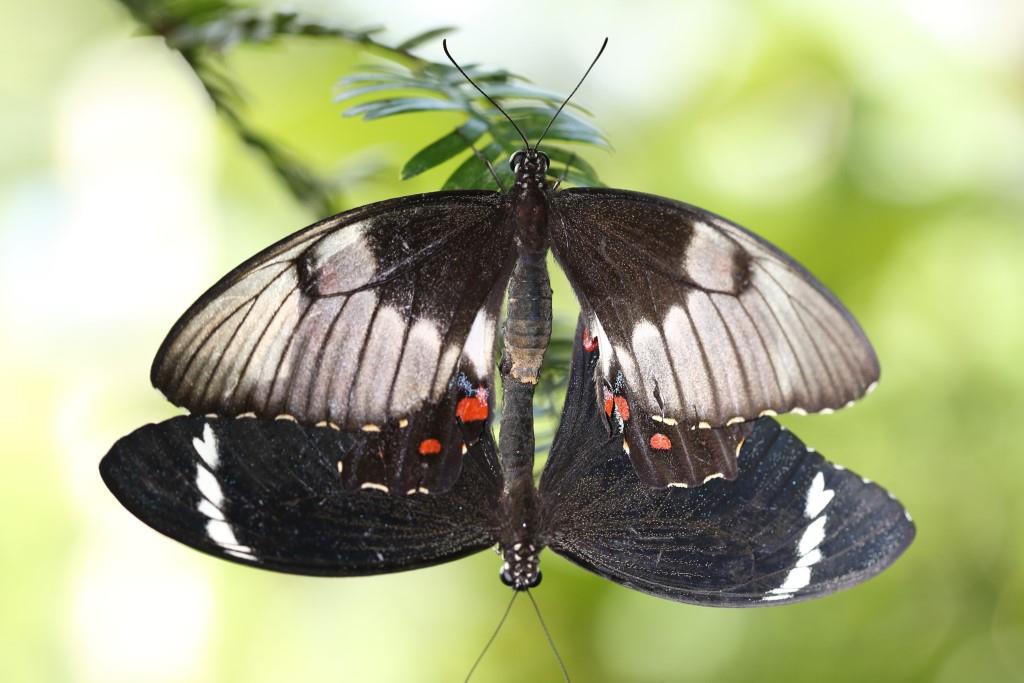
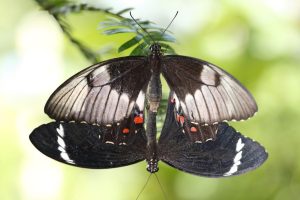
Courtship is undertaken by the male hovering above the female whilst she is flying or at rest on foliage, beating his wings and showering her with his sex scent (called pheromones). Mating occurs with the male hanging underneath the female in a trance-like state (called catalepsis), and generally lasts 45-60 minutes. During this time the female may undertake short flights with the male hanging immobile underneath.
- Diet
-
Caterpillars feed on nearly 40 species of food plants, including introduced citrus such as Orange (Citrus sinensis), Lime (Citrus aurantifolia), Mandarin (Citrus reticulata), Lemon (Citrus limon) and Grapefruit (Citrus paradisa), as well as native citrus (such as Citrus australasica and Citrus australis). Other native plants include Flindersia species, Zanthoxylum species and Dinosperma species.
- Natural enemies
-
Orchard Swallowtail caterpillars are attacked by birds, particularly Silvereyes, which take them from foliage, and the adults are caught on the wing by larger birds. Both caterpillars and adults are also captured by larger predatory insects and spiders. Assassin bugs prowling through foliage pierce the caterpillar’s skin and suck out the internal fluids. Diseases such as viruses and bacteria can sometimes affect the caterpillars, leaving the shrivelled victim hanging from leaves of the foodplant, but the incidence in the wild is probably uncommon. The adults may also be trapped by the proboscis in flowers of some introduced plants.
They are also attacked by parasitic insects in all stages other than the adults. Tachinid flies lay their eggs on leaves of the foodplants and, when these eggs are consumed by the caterpillar, the fly larva hatches and begins feeding on the caterpillar from the inside, eventually killing it.
The eggs, caterpillars and pupae are also attacked by several species of tiny parasitic wasps. Tiny egg parasites lay their eggs inside the butterfly’s egg, the wasp larva consuming the contents before emerging to fly off and infect other eggs. Caterpillar parasites lay their eggs on or in the host caterpillar and several dozen adult wasps may emerge from the caterpillar or pupa after it has been consumed. Caterpillars also suffer from viruses and bacteria that cause them to shrivel, leak liquid and die.
- Defences
-
Behind the caterpillar’s head is a bright red fleshy organ (called an osmeterium), which appears when the caterpillar is disturbed and releases a very pungent odour of rotting oranges to deter predators.
- Seasonal activity
-
The time spent as a pupa varies within the butterfly’s range, from three weeks near Sydney to 11 days further north. Pupation also takes longer during winter (about two months in Cairns), and in southern parts of the range the pupa will become dormant for six months to emerge in Spring. The determining factor seems to be daylength rather than temperature.
Adults can be seen throughout the year at Cairns but only from August to May in Brisbane, and October to May in Sydney. In Melbourne they appear during summer but generally do not breed.
- Behaviour
-
The adults’ flight is slow and erratic when cruising but they can fly very rapidly in swooping arcs when disturbed. Females are often seen flying around the food plant, landing with wings vibrating rapidly to feed at flowers or lay eggs. Males may fly along set pathways, often circling a wide area continuously in the same direction, to search for females and chase other males away.
Unlike many other butterfly species, Orchard Swallowtails hold the wings out to the side when at rest (figure x). The dark colour of the adults (particularly the males) absorbs heat from the sun and in tropical areas they tend to fly mainly in the shade, keeping the body temperature to about 37oC even when the outside temperature in the sunshine is up to 43oC
- Senses
-
The compound eyes of Orchard Swallowtails are large with excellent vision. Those of males may have more than 18,000 simple eyes in each compound eye. They are very sensitive to movement, and the butterflies are able to direct their vision as they move, being particularly aware of vertical or horizontal movements depending on whether the individual is searching for a mate, avoiding predators or searching for flowers or foodplants.
- Native/introduced
-
Native
- Conservation status
-
No concern
- Pest status
-
Although sometimes common on citrus, there are rarely more than a few caterpillars per tree and they generally cause little damage.
- Captive breeding
-
This species is widely reared, mostly on introduced Citrus, in butterfly houses in Australia and overseas.